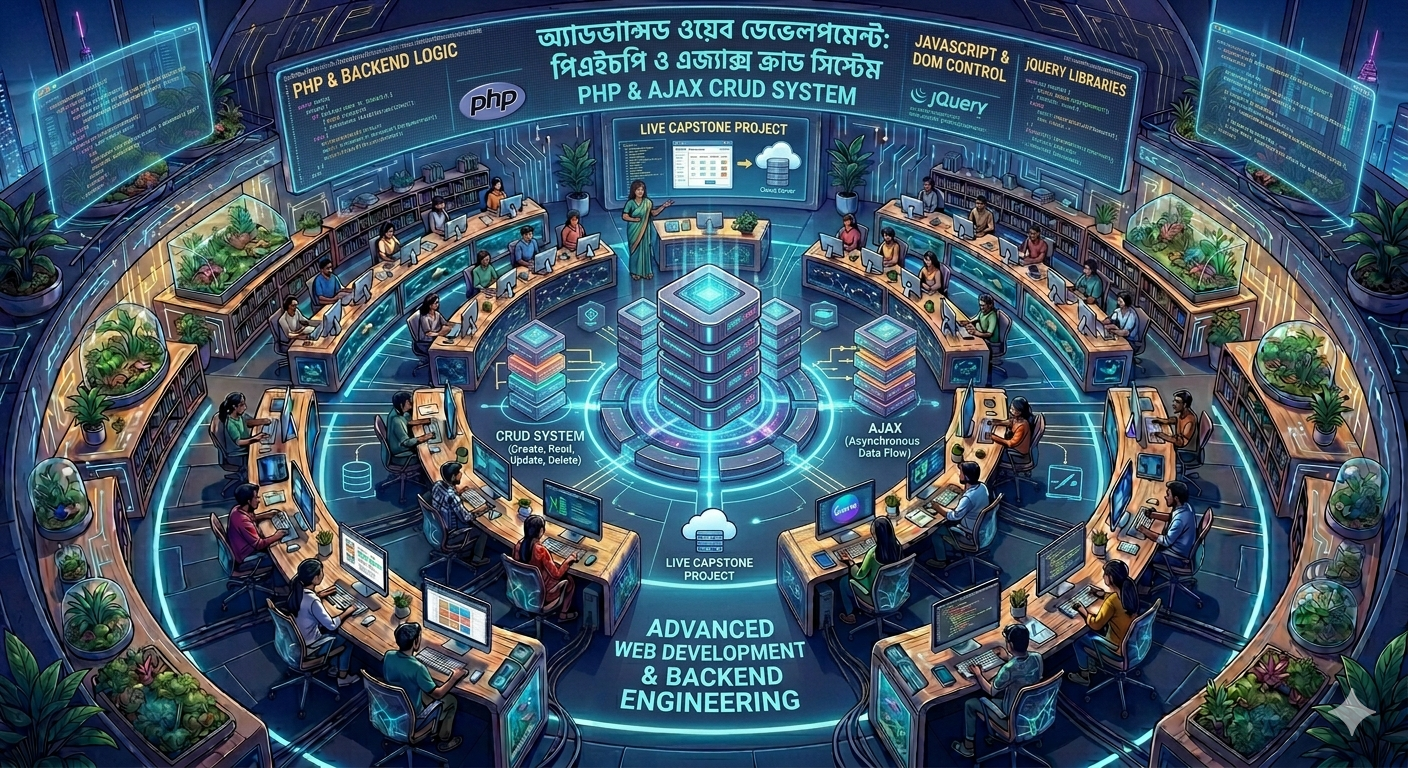
Master Dynamic Web Engineering: Advanced PHP & AJAX CRUD Course
Move beyond static design and step into backend application development! Learn how to build secure, database-driven web applications and create seamless, page-refresh-free user experiences using asynchronous data processing.
Course Overview
💡 100% practical, project-based training designed to turn you into a job-ready backend web engineer. Enroll today!
This course is engineered to transition students from basic interface layout to advanced backend application development. It focuses heavily on logic building, database communication, security protocols, and optimizing the user experience via seamless data transfers.
📅 Detailed Module-by-Module Curriculum
Module 1: PHP Foundations (The Server-Side Engine)
Backend Architecture: Understanding client-server architecture, local development servers (XAMPP/WAMP), and execution flow.
Core Language Syntax: Working with variables, data types, constants, arrays (indexed, associative, and multi-dimensional), and operators.
Control Structures: Implementing conditional logic (if, else, switch) and performance loops (for, while, foreach).
Superglobals & Data Capture: Utilizing $_GET and $_POST to capture, sanitize, and process form data securely.
Module 2: The Core CRUD System & Database Integration
Database Connectivity: Connecting PHP to MySQL securely using PDO (PHP Data Objects) or MySQLi.
SQL Essentials: Writing structured database queries to insert, retrieve, alter, and drop records.
The Blueprint Architecture: Developing a complete CRUD System:
Create: Constructing input pipelines to write fresh user data to tables.
Read: Fetching and organizing rows cleanly into HTML data tables.
Update: Programming data-population fields to edit active records safely.
Delete: Executing data-purging routines with parameterized filters.
Backend Security: Implementing basic protections against SQL Injection and Cross-Site Scripting (XSS).
Module 3: Advanced JavaScript & jQuery Operations
JS Execution Engine: Reviewing document traversal, data variable scopes, and event monitoring mechanics.
DOM Transformation: Utilizing jQuery wrappers to selectively target UI elements, manipulate HTML values, and toggle CSS layout styles dynamically.
Event Interception: Halting default browser actions (such as standard form validation refreshes) to execute custom script routines.
Module 4: AJAX (Asynchronous JavaScript and XML) Integration
The Asynchronous Concept: Understanding how web data can be transferred in the background without refreshing or reloading the active web page.
jQuery AJAX Shorthand: Mastering $.ajax(), $.get(), and $.post() methods.
Data Serialization: Packing entire user forms instantly using jQuery .serialize() for background delivery.
JSON Processing: Sending, parsing, and rendering JavaScript Object Notation (JSON) payloads between the client browser and the PHP server pipeline.
Module 5: The Live Production Project
System Wireframing: Designing the layout architecture for a real-world web app (e.g., an Inventory Controller, Student Register, or Task Management Portal).
Asynchronous Integration: Building out the full application stack, ensuring that every Create, Read, Update, and Delete function operates instantly via AJAX without a single page flash.
Testing & Deployment: Debugging network network payloads using browser development tools, cleaning variable loops, and hosting the final application on a live remote server.
🎯 Key Career Benefits of This Course
True Functional Capabilities: You graduate with the ability to build functional web software, moving past basic design into actual database engineering.
Modern UX Competency: Mastering AJAX sets you apart from standard developers by ensuring you can deliver the slick, instant-loading interfaces that modern users expect.
Portfolio Power: You walk away with a fully functional, database-driven web application asset that you can demonstrate to prospective clients or technical interviewers.