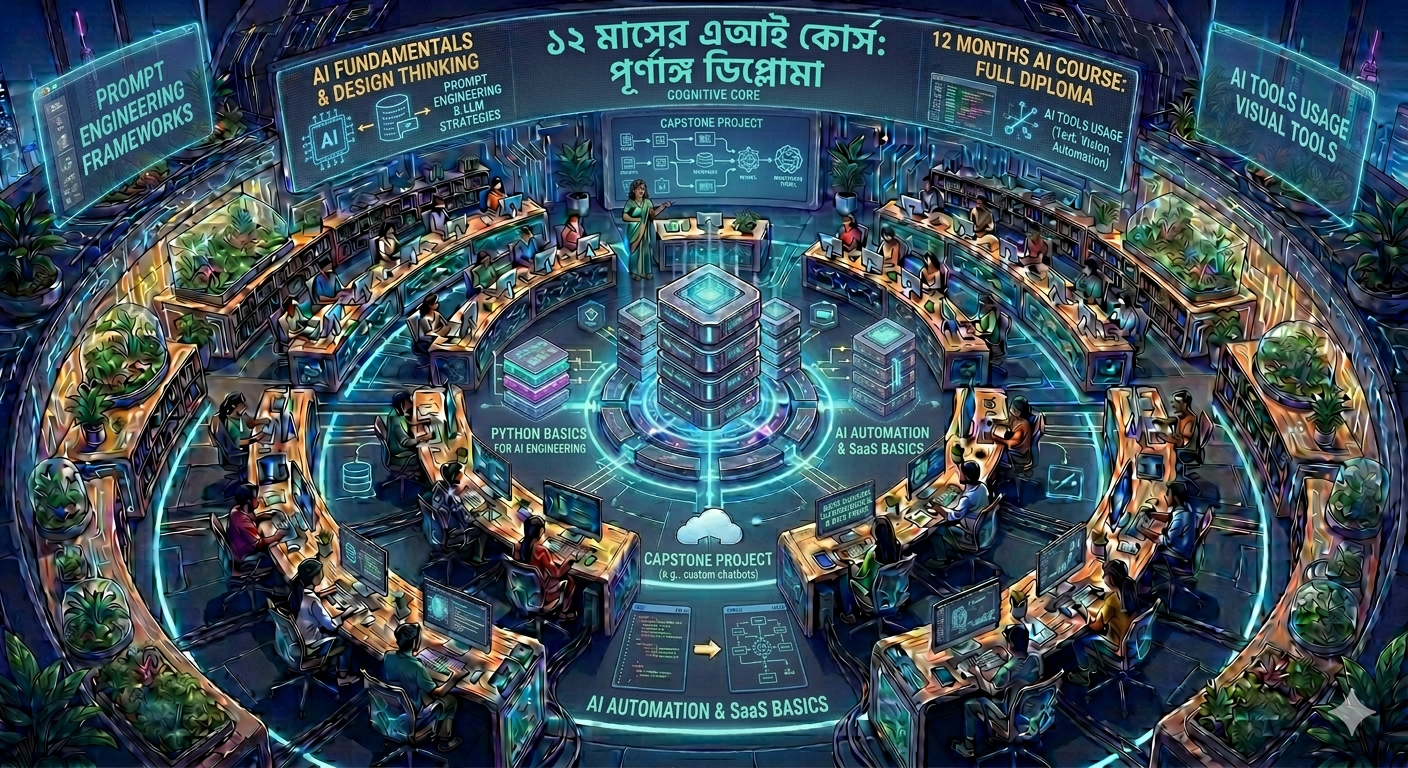
12-Month Master Diploma in AI & Intelligent Automation
Go from an AI user to an AI developer! This elite, 12-month professional program bridges the gap between utilizing generative tools and coding your own intelligent software. Master prompt frameworks, automate enterprise pipelines, build custom applications using the OpenAI API, and launch your own AI SaaS.
Course Overview
This intensive 12-month curriculum takes students through the complete AI spectrum. You will progress systematically from writing strategic natural language prompts to writing production-ready Python scripts, interacting with industry-leading neural network APIs, and deploying full-scale Machine Learning applications.
📅 12-Month Structural Curriculum Breakdown
Module 1: AI Fundamentals & Cognitive Mechanics (Months 1-2)
The Intelligence Landscape: Understanding Narrow vs. General AI, Deep Learning, and Neural Networks.
Large Language Models (LLMs): How transformer models process tokens, predict context parameters, and manage memory windows.
AI Ethics & Bias Mitigation: Managing data privacy regulations, diagnosing model hallucinations, and ethical utilization.
Module 2: Advanced Prompt Engineering Frameworks (Month 3)
Structural Prompt Architecture: Crafting system instructions utilizing Roles, Strict Constraints, and Target Formats.
Advanced Context Control: Mastering Zero-shot, Few-shot, and Chain-of-Thought (CoT) sequential processing.
Enterprise Prompt Libraries: Developing complex multi-step prompt chains to analyze large scale business datasets, generate system documentation, and run code logic diagnostics.
Module 3: Enterprise AI Tools Mastery (Month 4)
Text & Data Intelligence: Advanced implementation of ChatGPT, Gemini, and Claude for data analytics.
Generative Media Systems: Utilizing Midjourney, Stable Diffusion, and audio/video platforms for high-fidelity asset design.
Productivity Engines: Accelerating UI workflows using Figma AI plugins and smart presentation engines.
Module 4: Python Programming Foundations (Months 5-6)
Language Basics: Setting up Anaconda environments, mastering variables, expressions, arrays, and standard data types.
Control Flow Logic: Programming conditional branches (if-else) and data-processing loops (for, while).
Data Structures & File I/O: Manipulating Python Lists, Dictionaries, and reading/writing external JSON and CSV files.
Functional Programming: Writing reusable code blocks, managing packages via pip, and handling runtime exceptions.
Module 5: OpenAI API Integration & Custom AI Apps (Months 7-8)
API Architecture: Understanding RESTful communication endpoints, bearer tokens, and request/response structures using Postman.
OpenAI SDK Implementation: Connecting Python scripts to the OpenAI API to query gpt-4o engines programmatically.
Parameter Tuning: Tuning model responses using Temperature, Top-P, and Max Tokens variables.
Core API Projects:
Project 1: Building a custom, context-aware customer support chatbot using Python terminal structures.
Project 2: Developing an automated article analyzer and SEO metadata generator script.
Module 6: AI Automation & SaaS Foundations (Month 9)
Workflow Automation Engines: Wiring web applications together natively using Make.com and Zapier API loops.
Web UI Frameworks: Introduction to Streamlit or Gradio to transform raw Python AI scripts into clickable, professional web interfaces.
SaaS Architecture Basics: Understanding how software-as-a-service structures operate, tracking multi-user access variables, and structuring basic API monetization principles.
Module 7: Core Machine Learning Frameworks (Months 10-11)
Data Engineering Baselines: Introduction to NumPy and Pandas libraries for cleaning raw data datasets.
Supervised Learning: Building predictive systems using Linear Regression and Classification Algorithms (Decision Trees).
Model Training Mechanics: Splitting data matrices into Training vs. Testing sets, analyzing model accuracy metrics, and plotting analytical results using Matplotlib.
Module 8: Live Capstone Project & Deployment (Month 12)
Enterprise Application Design: Planning and architecting a complex AI application (e.g., an automated AI SaaS Writer, an intelligent HR Resume Screening tool, or an interactive data analysis panel).
Full-Stack Engineering Assembly: Writing clean backend Python structures, utilizing custom OpenAI API endpoints, integrating machine learning modules, and wrapping the code inside a modern visual web dashboard.
Production Deployment: Publishing the completed application live onto cloud hosting servers (such as Render, Streamlit Cloud, or Vercel) for your global professional portfolio.
🎯 Key Career Benefits of the 12-Month Diploma
The Dual Threat Developer: You don't just rely on standard prompt web interfaces; you acquire the Python skills needed to program, build, and adapt AI models natively.
SaaS Entrepreneurship Ready: Learning how to connect user interfaces with API processing sets you up to build and launch your own digital subscription software.
Elite Portfolio Authority: Graduate with an extensive personal repository containing live, interactive cloud links to web software you built, coded, and deployed from scratch.